Silicone O Rings are small, flexible sealing components with an important job. They sit inside a groove and prevent liquids or gases from escaping between two connected surfaces. Their smooth, rubbery profile may look simple. The engineering is not.
This article examines what Silicone O Rings are, how they work, and where manufacturers commonly use them. These seals perform well across broad temperature ranges. They also resist weathering, ozone, sunlight, and many aging effects. That makes them useful in food equipment, medical devices, electronics, pumps, valves, and outdoor machinery. Their soft material can conform to tiny surface imperfections. However, that flexibility has limits.
Dr. Robert Flitney, a recognized sealing-technology author, has emphasized, “A seal’s performance depends on the complete sealing system, not the material alone.” This principle deserves attention. Groove design, compression, surface finish, pressure, temperature, and chemical exposure all influence reliability. A silicone O-ring may survive heat but swell in an unsuitable fluid. It may seal gently but fail under severe abrasion or high-pressure extrusion.
The following sections connect material properties with practical selection decisions. They also explain static and dynamic sealing, sizing, hardness, installation, and maintenance. Real-world failures often begin with small details, such as a twisted ring or a scratched groove. Even experienced teams can overlook them. Silicone O Rings are dependable, but they are not universal. Careful testing remains necessary when safety, cleanliness, or long service life matters.
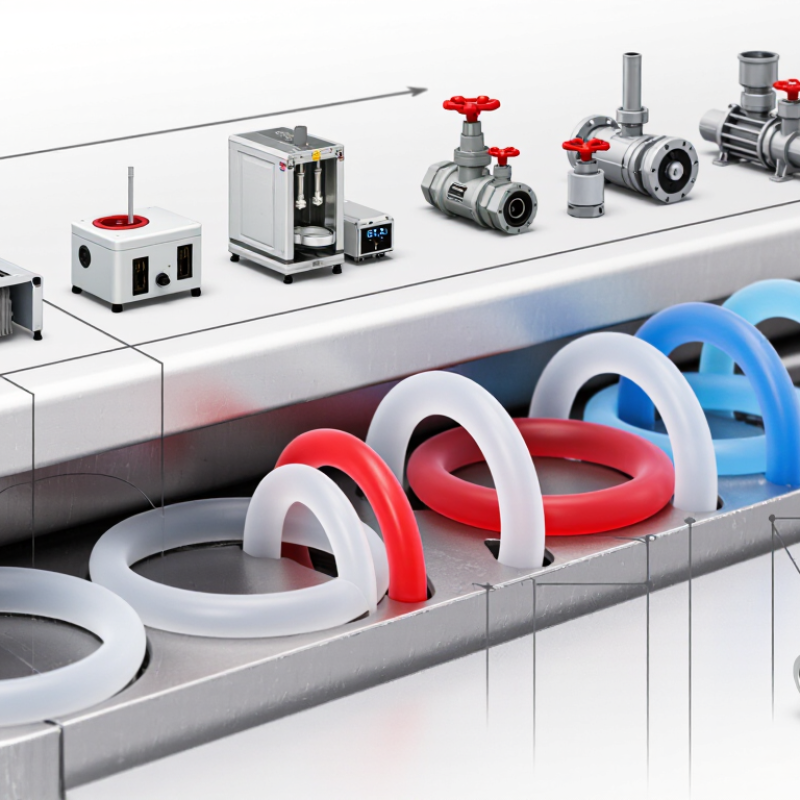
Silicone O-rings are flexible, circular seals made from silicone rubber. Their simple shape hides a precise job. When compressed inside a machined groove, the ring fills tiny gaps between two surfaces. This blocks air, water, dust, and selected fluids from passing through. Unlike a flat gasket, an O-ring usually seals with less material and fits compact assemblies. Its smooth, rounded profile supports repeated assembly when the groove and surfaces are properly designed. In practical maintenance work, clean handling matters more than many people expect. A fingerprint can carry grit.
Silicone is valued for its wide temperature range, low-temperature flexibility, and resistance to weathering and ozone. It stays soft where some rubber compounds become stiff. This makes silicone O-rings useful in lighting housings, food-processing equipment, medical devices, pumps, sensors, and outdoor enclosures. Their color is not a reliable quality indicator. Compound formulation and curing quality matter more. Important detail: silicone has limited resistance to abrasive wear, tearing, and some fuels or oils. It is not a universal seal.
Choosing one requires more than matching the diameter. Engineers check groove dimensions, compression, pressure, temperature, fluid contact, and expected movement. A loose ring may leak. Excessive compression can shorten its life. Installation should use compatible lubrication, clean tools, and no twisting. Field inspections often reveal damage from sharp metal edges during assembly. That mistake is easy to miss. The design may be right, yet the installation can still fail.
| Data Dimension | Information | Practical Significance |
|---|---|---|
| Definition | A silicone O-ring is a torus-shaped sealing ring made from silicone rubber, commonly identified as VMQ in elastomer classifications. | It forms a seal by being compressed between two mating surfaces, helping prevent the passage of liquids or gases. |
| Basic Sealing Principle | The circular cross-section is compressed inside a groove when two components are assembled. | The resulting contact pressure creates a static seal and, in suitable designs, can also support limited dynamic sealing. |
| Typical Temperature Capability | Many silicone formulations operate approximately from -60°C to 200°C (-76°F to 392°F). The exact limits depend on the compound, design, pressure, and exposure conditions. | Silicone is useful where seals must remain flexible at low temperatures or resist continuous exposure to elevated temperatures. |
| Low-Temperature Flexibility | Silicone rubber generally retains flexibility better at low temperatures than many general-purpose sealing materials. | This supports sealing performance in cold environments, outdoor equipment, refrigeration-related systems, and temperature-cycling applications. |
| Weather and Ozone Resistance | Silicone has strong resistance to ultraviolet radiation, ozone, and weathering. | It is suitable for outdoor enclosures, lighting equipment, instruments, and other applications exposed to sunlight and air. |
| Chemical Compatibility | Silicone generally performs well with water, dilute aqueous solutions, and many environmental conditions, but compatibility varies with the fluid and formulation. | Fluid compatibility should be checked before use, especially when the seal contacts fuels, oils, concentrated acids, alkalis, or solvents. |
| Resistance Limitations | Silicone commonly has weaker resistance to abrasion, tearing, and certain petroleum-based fluids than several other elastomer families. | It may be unsuitable for abrasive motion, sharp edges, high-friction dynamic service, or prolonged contact with incompatible oils and fuels. |
| Gas Permeability | Silicone is relatively permeable to gases compared with many other elastomers. | For high-pressure gas retention or applications requiring very low gas transmission, another material may be more appropriate. |
| Common Applications | Typical uses include static seals in appliances, lighting systems, sensors, fluid-handling equipment, medical equipment, food-processing equipment, and outdoor devices. | These applications benefit from silicone’s broad temperature range, flexibility, cleanliness options, and weather resistance. |
| Static Sealing | Silicone O-rings are commonly used where the sealed parts remain stationary after assembly. | Static applications generally provide more predictable service because they place less demand on abrasion and tear resistance. |
| Dynamic Sealing | They can be used in some slow or carefully designed dynamic applications, but movement, lubrication, surface finish, pressure, and wear must be evaluated. | For frequent reciprocating or rotating motion, material selection and groove design are especially important. |
| Hardness Range | Silicone O-rings are manufactured in multiple hardness levels, commonly measured on the Shore A scale. | Lower hardness can improve conformity to irregular surfaces, while higher hardness can provide greater resistance to extrusion and mechanical damage. |
| Color and Visibility | Silicone compounds can be produced in different colors, including translucent and brightly colored versions. | Color may help with inspection, identification, or visual detection of the seal during assembly and maintenance. |
| Material Selection Factors | Selection should consider temperature, pressure, fluid exposure, motion, compression, groove dimensions, surface finish, and required service life. | A silicone O-ring should not be selected solely because it has a wide temperature range; the complete operating environment determines suitability. |
| Key Advantages | Wide operating-temperature capability, excellent flexibility, strong weather and ozone resistance, low compression-set performance in suitable conditions, and availability for hygienic applications. | These characteristics make silicone O-rings valuable for demanding temperature and outdoor sealing environments. |
| Key Disadvantages | Relatively high gas permeability, limited abrasion and tear resistance, and poor compatibility with some fuels, oils, and solvents. | These limitations must be balanced against the application’s pressure, motion, fluid, and durability requirements. |
| Installation Considerations | The groove should be clean and correctly sized; the O-ring should not be twisted, stretched excessively, cut, or installed over sharp edges. | Correct installation reduces leakage, premature wear, pinching, and damage during assembly. |
| Inspection and Maintenance | Periodic inspection should look for cracking, cuts, flattening, swelling, hardening, discoloration, and loss of elasticity. | Replacing damaged or chemically degraded O-rings helps maintain seal reliability and prevent unexpected leakage. |
| Important Note | Actual performance depends on the specific silicone compound, O-ring size, groove design, pressure, temperature, fluid, and installation method. | Always verify the manufacturer’s technical data and conduct application-specific testing for critical sealing systems. |
It is a flexible circular seal made from silicone rubber. It fits inside a machined groove. The ring blocks air, water, dust, and selected fluids.
Manufacturers mix silicone polymer with fillers, pigments, and curing agents. They shape the compound using molding equipment. Heat activates curing and creates elastic memory. Some rings receive additional post-curing.
Classification considers compound type, Shore A hardness, temperature range, and service conditions. Static and dynamic applications require different evaluations. Fluid exposure also matters. Material names alone are not enough.
They appear in valves, pumps, laboratory instruments, and heating systems. They also seal outdoor lighting and electrical enclosures. Food equipment uses them often. Small rings can stop large assemblies.
Many formulations work around -60°C to 200°C. The actual range depends on pressure, formulation, and design. Heat changes matter. Do not rely on a broad temperature label alone.
Not always. Many oils, fuels, and solvents can swell or weaken silicone. Check compatibility data before installation. Guessing from appearance is risky.
Check the fluid, temperature, pressure, movement, inside diameter, and cross-section. Confirm the groove dimensions and hardness. Softer rings follow tiny surface irregularities. Harder rings resist extrusion better. A rushed choice may fail.
Look for cuts, cracks, flattening, swelling, and shiny worn areas. Replace damaged rings. Clean the groove with a lint-free cloth. Store unused rings in a cool, dry, dark place. Keep them relaxed. Do not hang them on hooks.
Silicone O Rings are flexible, circular sealing components designed to prevent fluids, gases, dust, and other contaminants from passing between joined surfaces. They are produced by molding or cutting silicone compounds into precise dimensions, then classified by size, hardness, temperature rating, color, and the specific formulation used. Their performance can be adjusted for different operating conditions, making them suitable for both simple and demanding sealing tasks.
Key advantages of silicone O Rings include excellent flexibility, resistance to temperature changes, good weather and aging resistance, and reliable performance in many low- to medium-pressure applications. They are commonly used in equipment, appliances, fluid-handling systems, medical devices, and outdoor assemblies. Selecting the correct ring requires checking its dimensions, hardness, chemical compatibility, pressure requirements, and working temperature. Regular inspection, proper lubrication when appropriate, clean storage, and timely replacement can help prevent leakage and extend service life.

 101 Rubber